


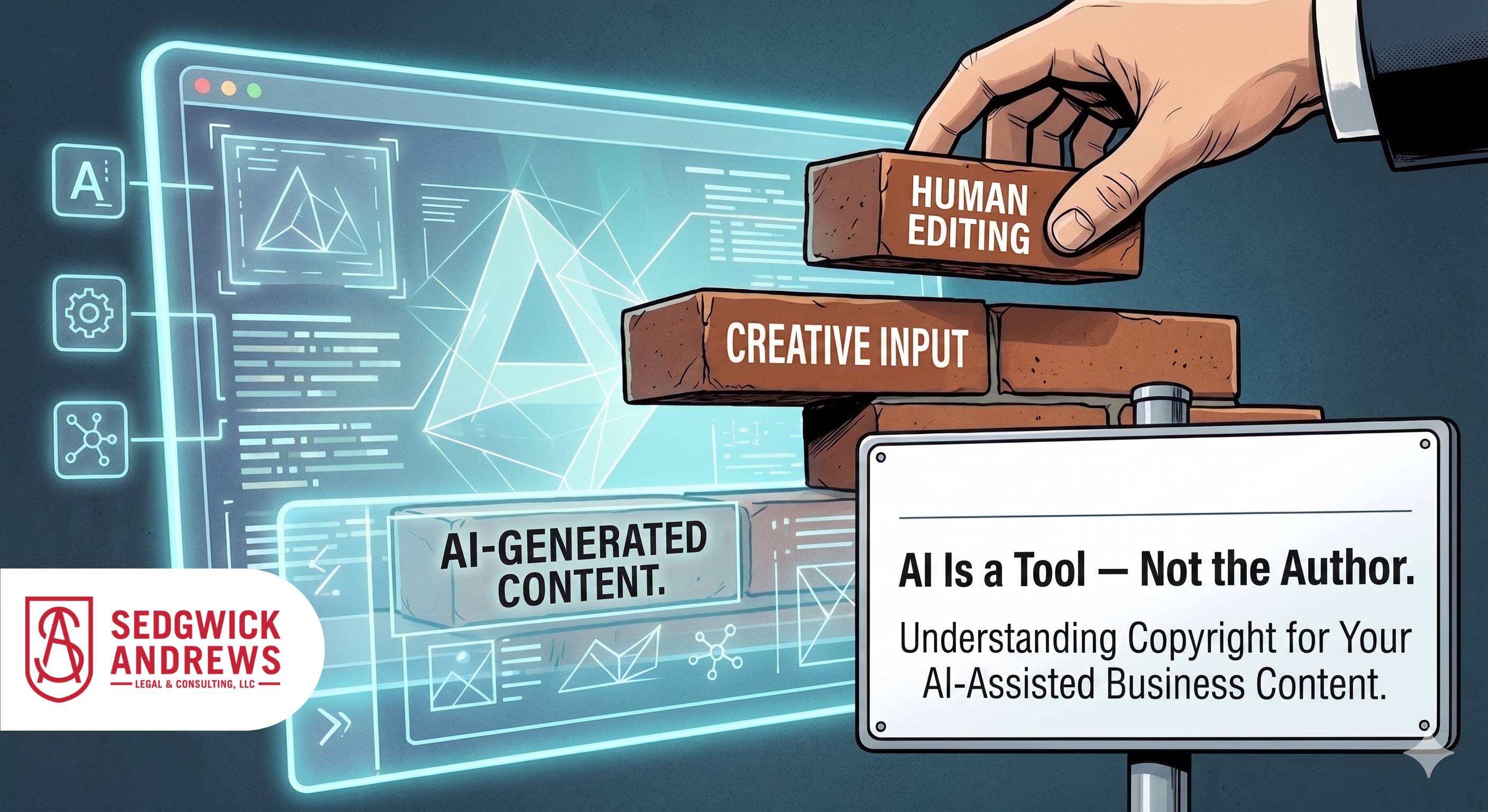
AI Is a Tool — Not the Author.
What Every Entrepreneur Needs to Know About Copyright and AI-Generated Content
Let’s get one thing straight: I love what artificial intelligence has done for small business owners. Tools like ChatGPT, Jasper, and others have made it possible to draft faster, create more, and show up professionally even on a shoestring budget. As a small business attorney, I’ve watched entrepreneurs use AI to punch well above their weight class — and I am here for all of it.
But here’s the part of the conversation that’s not happening loudly enough: if your business’s content strategy relies on AI-generated material, you may be building on a foundation you don’t actually own. And in business, what you can’t protect, someone else can take.
Let me explain why this matters — and what you can do about it right now.
The Law Is Clear: AI Cannot Be a Copyright Author
Back in March 2023, the U.S. Copyright Office issued formal guidance establishing that copyright protection requires human authorship. The Office made clear that when AI technology independently determines the expressive elements of a work — the words, the structure, the imagery — that work does not qualify for copyright protection under U.S. law.
The legal basis for this position is not new. Courts have applied the human authorship requirement for well over a century, rooted in foundational Supreme Court precedent holding that an “author” means a human being — a person — not a machine.
“When an AI technology determines the expressive elements of its output, the generated material is not the product of human authorship. As a result, that material is not protected by copyright.”— U.S. Copyright Office, March 2023
Practically speaking, this means that a prompt you type into an AI tool functions more like a commission request than an act of authorship. You told the machine what you wanted. But the machine decided how to say it.
The Supreme Court Just Confirmed It: This Rule Is Here to Stay
For those following this legal debate, there was one remaining question: would the courts eventually overturn the Copyright Office’s position? That question was answered definitively on March 2, 2026.
The U.S. Supreme Court declined to hear the case of Thaler v. Perlmutter — a years-long legal challenge brought by computer scientist Dr. Stephen Thaler, who argued that his AI system (which he named DABUS) should be recognized as the author of a visual artwork it autonomously created. Dr. Thaler was not claiming authorship for himself. He was arguing that the AI itself should own the copyright.
Every court that reviewed the case — the Copyright Office, the U.S. District Court, and the D.C. Circuit Court of Appeals — rejected that argument. The D.C. Circuit called human authorship a “bedrock requirement of copyright.” When the Supreme Court chose not to hear the case, that ruling became the final word, at least for now.
The message from courts and regulators could not be more consistent: if you want intellectual property protection, there must be a human meaningfully involved in the creative process.
Why This Is a Real Business Risk
Here is where the rubber meets the road for entrepreneurs. Many of you are creating content at scale — blog posts, social media captions, website copy, email newsletters, ebooks, course materials, and more. AI has made that volume possible. But if that content was generated entirely by AI with minimal human creative input, you cannot claim copyright ownership over it.
What does that mean practically? Consider the following scenarios:
- A competitor uses content that closely mirrors what your AI tool generated. You want to claim infringement — but you have no copyright to enforce.
- You publish an ebook for sale. A registrant complains it was AI-generated. You may not be able to defend your ownership in court.
- You try to register your brand materials with the Copyright Office and discover the AI-generated portions must be disclaimed — and may not be protectable.
None of these scenarios are hypothetical. They are the logical result of a legal framework that is now firmly established.
There Is a Path Forward — And It Starts With Human Authorship
Here is the good news: the Copyright Office has been equally clear that AI-assisted works can be protected when a human being has made sufficiently creative contributions to the final product. The key distinction is between AI as a tool and AI as the author.
What Qualifies for Copyright Protection
Think of AI the way you would think of Adobe Photoshop, Canva, or a word processor. Those are tools. You are still the author. The same logic applies when you use AI — provided that you are doing more than simply entering a prompt and publishing the output unchanged.
Copyright protection is available when a human author:
- Substantially edits, rewrites, or restructures AI-generated output using their own creative judgment
- Selects and arranges AI-generated material in a creative, original way
- Combines AI-generated content with original human-authored content in a meaningful way
- Uses AI-generated material as a starting point and transforms it into something distinctly their own
In those cases, copyright protects the human contributions — not the raw AI output, but your creative expression layered on top of it.
Practical Steps to Protect Your Business
As your trusted legal advisor, here is what I recommend you build into your content creation process right now:
1. Document Your Human Contributions
Keep a record of how you use AI in your content workflow. Note what you prompted, what you edited, and what decisions you made. This documentation is your evidence of human authorship.
2. Make It Yours — Substantively
Don’t publish AI drafts as-is. Rewrite, reorganize, add your voice, your examples, your expertise. The more of you that shows up in the final product, the stronger your ownership claim.
3. Disclose Accurately on Copyright Applications
If you are registering any work with the U.S. Copyright Office, be truthful about AI’s role. The Office requires disclosure of AI-generated material. Failing to disclose — or worse, registering material you know to be purely AI-generated — can result in cancellation of your registration and legal exposure in future infringement actions.
4. Get Legal Counsel on High-Stakes Content
For your ebooks, courses, contracts, brand materials, and other core intellectual property assets, work with an attorney to ensure your content is properly protected. These are the assets that drive revenue. Protect them accordingly.
The law has spoken. AI can power your process — but it cannot be your author. Your voice, your judgment, and your creative direction are what make your content yours to own.
The Bottom Line
AI is one of the most powerful business tools available to entrepreneurs today. I encourage you to use it — strategically, intentionally, and with your eyes open. But do not let the convenience of AI-generated content lull you into believing you own something you may not legally be able to protect.
Your business is built on your expertise, your brand, and your ideas. Make sure the law recognizes them as yours.
Have questions about protecting your intellectual property or creating a compliant content workflow? Sedgwick Andrews Legal & Consulting is here to help.
